The Auction Was at 1:00 PM. We Found Out That Morning.
A Central Islip homeowner hired me nine days before his property was ultimately sold at foreclosure auction. I had already started investigating the title and working on a buyer, but neither of us had reliable paperwork showing exactly when the auction would occur.
On the morning of August 14, that changed. By the time I found the court record confirming a 1:00 PM auction, we had only a few hours to get the buyer, seller and attorneys moving at the same time.
We tried.
We ran out of time.
If you are somewhere on that timeline right now, read What if I’m behind on my mortgage or facing foreclosure? alongside the foreclosure guide.

This case describes one real transaction and is not legal advice. I am a Licensed New York Real Estate Broker. Attorneys handled the legal work described in this case.
The Seller Hired Me. I Started With the Title.
The homeowner signed with me on August 5, 2026. Because the property was already in foreclosure, my first concern was not simply putting it on the market. I wanted to understand what was actually attached to the property and whether a sale could realistically work, so I immediately ordered a title search.
The title company turned it around in roughly three days and, because of our existing business relationship, did not charge the seller for the search. The result was encouraging. As I remember it, the title search showed the bank-related foreclosure liens but no unexpected judgments, mechanic's liens or other additional liens complicating the property.
That could have been much worse. At that point, there appeared to be a path to selling the property if we could move quickly enough.
Andrew’s recollection of the title results. Supporting title documentation may be added later if appropriate.
The Hardest Part Was Figuring Out When the Auction Was Actually Happening.
Throughout the time I was working with the seller, he was receiving unsolicited calls and text messages from people interested in buying the property. The messages were all over the place. One person might tell him the foreclosure sale was a month away, someone else would say a week, and someone else would say only a few days.
I kept asking him for the actual notices he had received, but he couldn't find them. He explained that mail had sometimes been thrown away in the household, so for several days he continued searching the house hoping the foreclosure notices would turn up.
Eventually he told me:
“I have nothing.”
That uncertainty cost us time. The important question was no longer what random callers were telling him. We needed the actual court record.
Something Was Clearly Different That Morning.
Early on August 14, the homeowner called me before leaving for work. He was nervous because people he did not know were showing up at the property, and he told me his security cameras showed people looking around the house and attempting to access areas of the property.
A family member was still home, which made him especially concerned. I told him that if he believed people were attempting to enter the property, he should contact the police.
But the sudden activity told me something else. There had to be a reason so many prospective buyers were showing up that morning. After days of conflicting information about the foreclosure date, I began to suspect the auction might actually be happening that day.
I Started Reconstructing the Court File.
When the government offices opened, I started trying to locate the actual foreclosure information. I contacted the clerk's office and was directed to the court records.
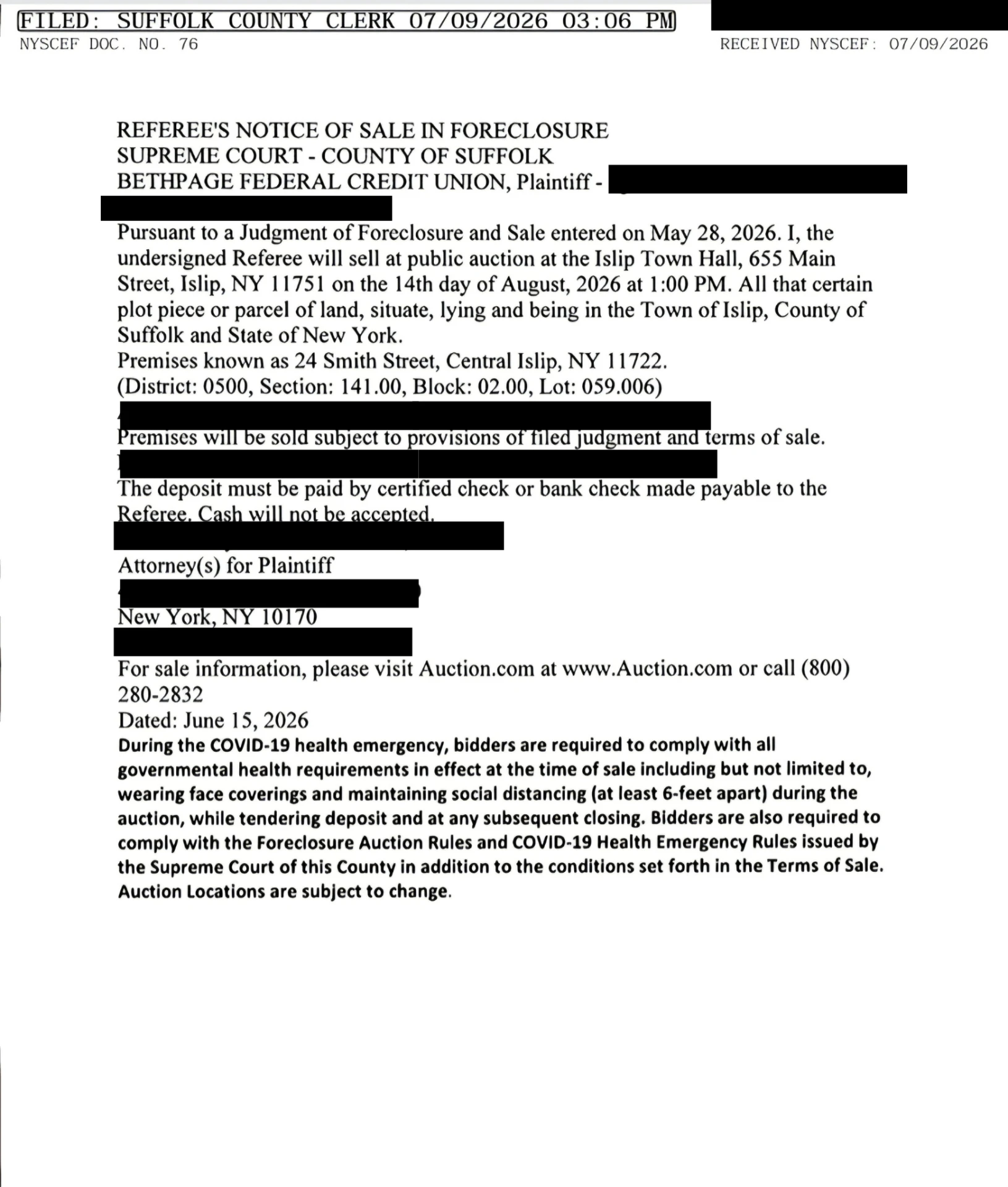
Using the foreclosure index information, I was able to locate the public court documents and work through the foreclosure filings until I found the document we needed: the Notice of Sale.
August 14, 2026
1:00 PM
That was the same day. We had only hours left.
The Transaction Became an Emergency.
As soon as I saw the auction time, I called the buyer and showed him the same Notice of Sale. I told him, in substance, "You want this property. We have to hustle." The buyer immediately contacted his attorney, and I contacted the real-estate attorney representing the seller — an attorney I regularly work with and trust.
From that point forward, all of us were moving at the same time. The buyer was working with his attorney, the seller's attorney was working on his side, and I was coordinating the real-estate transaction, documents and communication.
The seller, who would normally have been working throughout the day, stayed available by phone and stood by to electronically sign anything we sent him. Once everyone knew the real deadline, everyone cooperated.
The Seller’s Attorney Became the Effective Legal Contact.
I also tried calling the contact associated with the foreclosure and left a voicemail, but that did not produce the response we needed. The seller's attorney was more effective.
Using the information from the Notice of Sale, he located the foreclosing attorney's email address and contacted them directly. That attorney-to-attorney email communication generated a response, and the foreclosing side asked for documentation showing that there was a legitimate transaction being assembled, including the contract of sale and buyer proof of funds.
That distinction matters. I was driving the real-estate side of the transaction, while the seller's attorney handled the legal communication with the foreclosing side. I was not acting as the foreclosure attorney.
Andrew investigated the property and public records, coordinated the buyer and real-estate transaction, and assembled the people and information needed on the brokerage side.
The seller’s attorney handled the legal communications and effort to obtain a postponement of the foreclosure sale.
We Had a Real Buyer With Funds Available.
The property was distressed and needed a buyer capable of dealing with its condition and an unusually compressed timeline. I had already located that buyer.
The negotiated purchase price was:
$160,000
The buyer also provided proof of funds. That document contains private buyer financial information, so it is not published as part of this case study.
I Was Also Trying to Reduce the Seller’s Costs.
This was a distressed sale, and the homeowner was already facing the loss of his property. I didn't want the entire brokerage cost coming out of whatever proceeds he might still have left, so I structured the compensation between the buyer and seller instead of placing the full burden on the homeowner.
The arrangement was disclosed and agreed to in writing by everyone involved.
We Were Still Trying With Minutes Left.
The attorneys worked as quickly as they could to put the contract together. The buyer's proof of funds was available and the transaction terms had been negotiated, but there simply wasn't enough time to get every piece completed before the auction.
Approximately ten minutes before the scheduled 1:00 PM sale, the available transaction documentation was submitted to the foreclosing side. The contract was not yet fully executed.
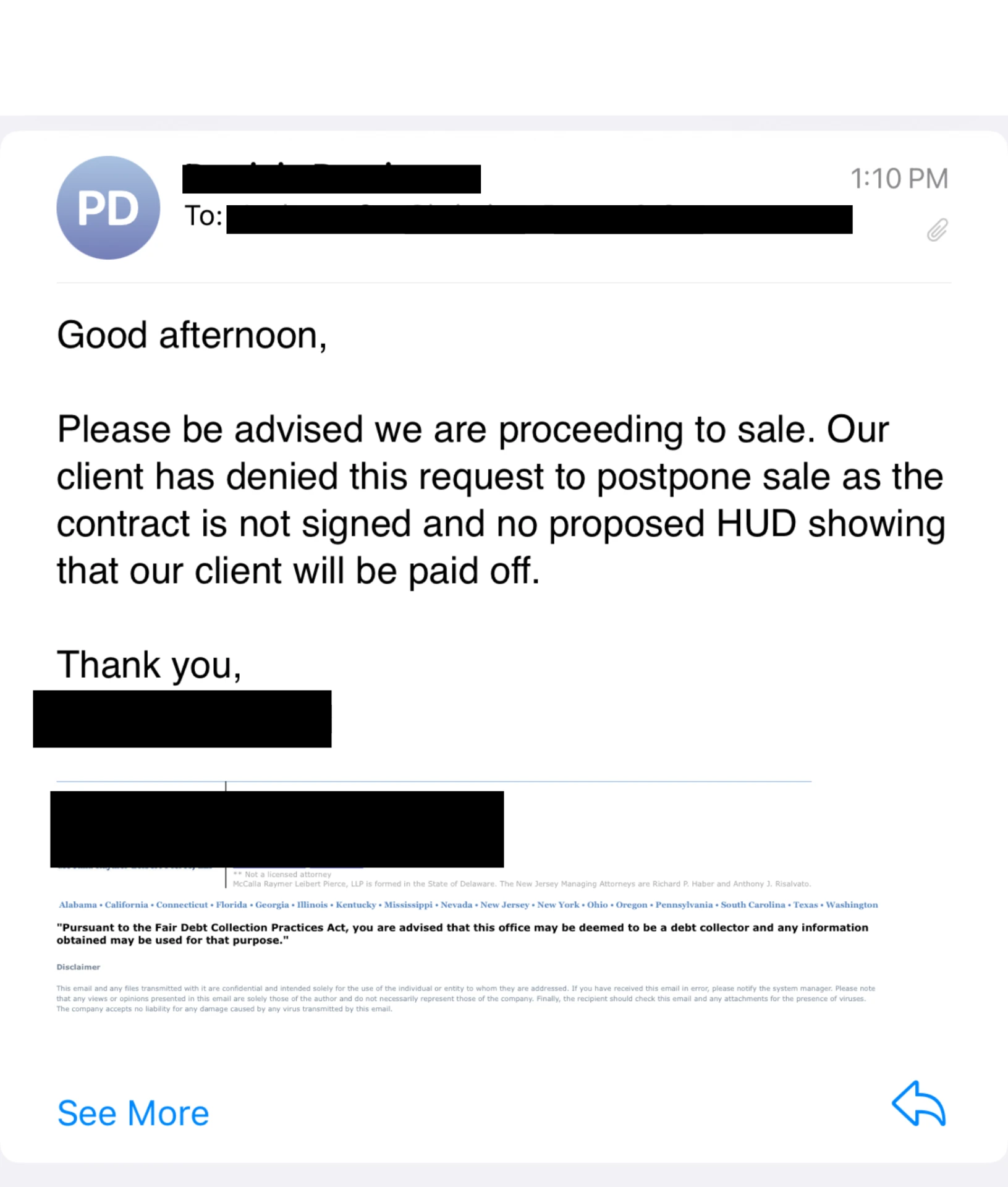
Later written correspondence from the foreclosing attorney's office stated that the request to postpone the sale had been denied because the contract was unsigned and there was no proposed HUD showing that their client would be paid off.
The message said:
“We are proceeding to sale.”
The Property Was Sold at Foreclosure Auction.
We did not get there in time. The property proceeded to foreclosure sale on August 14, and the homeowner lost the house.
There is no version of this case where I can honestly say that we succeeded, but that is exactly why I think the story is worth telling.
What we could not manufacture was more time.
Nine Days.
- AUG 5
Hired
- AUG 5–8
Title Search
- FOLLOWING DAYS
Buyer Found Deadline Unclear
- AUG 14 · ~7 AM
Activity at House
- ~9 AM
Court Record Found
- 1 PM
Foreclosure Auction
The Problem Wasn’t Finding a Buyer. It Was Running Out of Time.
We found the buyer. That wasn't ultimately the problem. The larger problem was that too much of the timeline remained uncertain until the very end.
The seller did not have the foreclosure notices, people contacting him were giving him contradictory dates, and several days disappeared while he searched for paperwork that never turned up. By the time I independently found the Notice of Sale, the auction was only hours away.
I cannot say that contacting me earlier guarantees that someone can stop a foreclosure. It doesn't. Every situation is different, and legal questions need to be handled by the appropriate attorney.
What this transaction taught me is that if a foreclosure is already moving forward, uncertainty is dangerous. The earlier we can establish what is actually happening — the title, the court case, the deadlines, the property condition, the buyer options and the professionals who need to be involved — the more time there is to determine whether a workable path still exists.
The House We Were Trying to Sell


The house was occupied and in original condition. It was sellable — there was simply not enough time left on the calendar.
Start by Finding Out What Is Actually Happening.
If a foreclosure has already started, the first question is not always simply, "What can I sell the house for?" The timeline, title, court status, property condition and available buyer options can all affect what is realistic.
I can help investigate the real-estate side, understand the property and sale options, and coordinate with the appropriate professionals when legal or title work is required. I am not a foreclosure attorney, and I do not provide legal advice.
For the fuller explanation of how I approach these situations, read my guide to foreclosure, property auctions and short sales, or browse all case studies.
Let’s just talk first.
No obligation and no pressure. Tell me a little about your situation and I’ll get back to you myself.