

A real estate settlement is the final phase of a property transaction where ownership legally transfers from seller to buyer and every financial obligation is reconciled down to the last dollar. Most people call it “closing,” but settlement specifically refers to the detailed accounting process that makes the transfer official. It involves the buyer, seller, lender, and a settlement agent working through documents like the Closing Disclosure and the ALTA Settlement Statement. Understanding how this process works protects you from surprises, delays, and costly mistakes.
What is a real estate settlement and why does it matter?
A real estate settlement is defined as the detailed financial reconciliation that converts every contractual obligation into precise dollar amounts before property ownership changes hands. The contract you signed weeks earlier set the terms. Settlement is where those terms become real money moving between real accounts.
Settlement matters because it is the point of no return. Once funds are disbursed and documents are signed, reversing any error becomes expensive and legally complicated. The settlement agent, often a title company or real estate attorney, acts as a neutral party who collects funds, pays off existing mortgages, distributes commissions, and records the deed. Every party’s financial rights depend on this process being done correctly.

The term “settlement” is used most commonly in Mid-Atlantic states like Maryland, Virginia, and Pennsylvania. In other parts of the country, the same event is called “closing.” The mechanics are identical. The difference is regional vocabulary, not process.
What happens during the real estate settlement process?
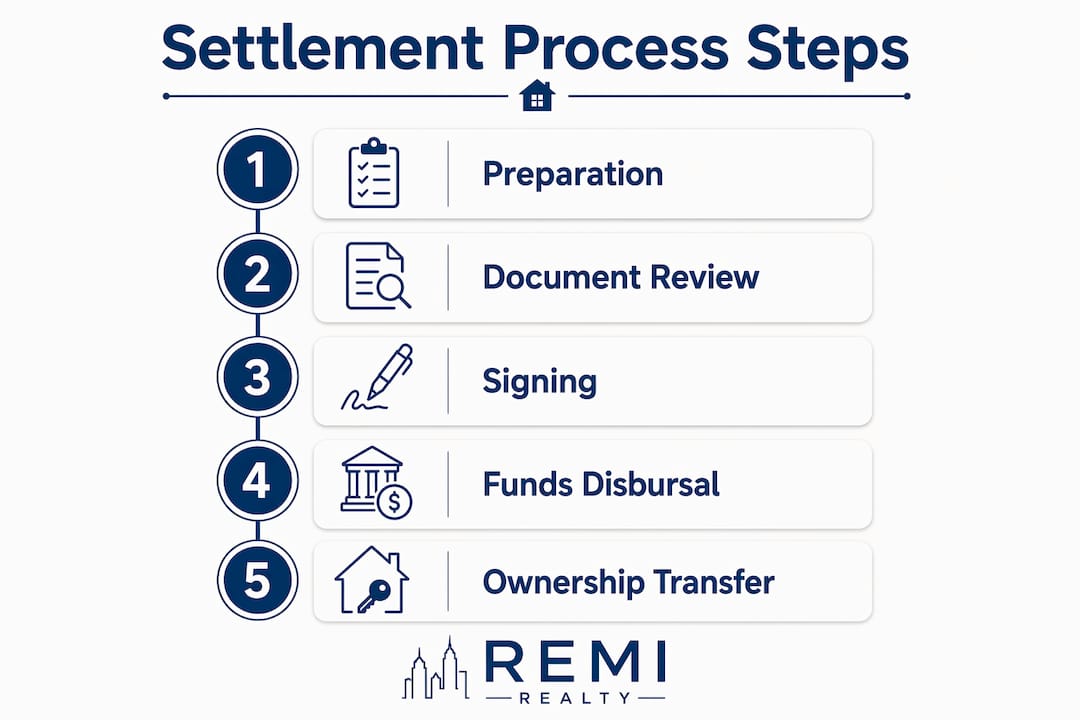
The settlement process follows a defined sequence. Knowing each step prevents confusion and keeps you from signing documents you do not understand.
-
Receive and review the Closing Disclosure. Federal regulations require that buyers receive the Closing Disclosure at least three business days before closing. This gives you time to compare it against your Loan Estimate and flag any changes.
-
Review the ALTA Settlement Statement. The ALTA Settlement Statement provides a more detailed, localized account of all fees and credits beyond what the federally mandated Closing Disclosure covers. Your title company or attorney prepares this document.
-
Bring certified funds. Buyers must arrive with a cashier’s check or wire transfer for the exact amount shown on the settlement statement. Personal checks are not accepted.
-
Sign the documents. You will sign the deed, the promissory note, the mortgage or deed of trust, and multiple disclosure forms. Sellers sign the deed and any transfer documents. This signing event can take 45 minutes to over an hour.
-
Settlement agent disburses funds. After signing, the settlement agent pays off the seller’s existing mortgage, distributes the real estate commissions to the agents involved, and sends the seller their net proceeds.
-
Deed is recorded at the county office. The official ownership transfer is completed when the deed and mortgage are recorded at the county recorder’s office, often hours or even a day after the signing event. You are the legal owner once recording is confirmed.
Pro Tip: Request a draft of the ALTA Settlement Statement at least 24 hours before your settlement date. Reviewing it the night before gives you time to ask questions without holding up the table.
How to read a settlement statement in real estate
The settlement statement is the most misunderstood document in the entire real estate closing process. Clients often confuse the Closing Disclosure with the ALTA Settlement Statement, and that confusion costs them negotiating confidence at the worst possible moment.
Here is the core difference between the two documents:
| Document | Who prepares it | What it covers |
|---|---|---|
| Closing Disclosure | Your lender | Loan terms, monthly payment, federally regulated fees |
| ALTA Settlement Statement | Title company or attorney | All transaction fees, credits, prorations, commissions |
Both documents use a debit and credit system. A debit is money you owe. A credit is money applied in your favor. The same line item can appear as a debit on the buyer’s side and a credit on the seller’s side. This mirrors how the money flows. Settlement statements list every dollar as a debit or credit for both sides, which confuses clients when the same item appears on both sides to create the final balance.
Common line items you will see on a settlement statement:
- Sale price: Debit to buyer, credit to seller
- Loan amount: Credit to buyer (the lender is paying this portion)
- Real estate commissions: Debit to seller
- Title insurance: Debit to buyer or seller depending on local custom
- Property tax proration: Debit to seller if taxes are owed for the period they owned the home
- Homeowner’s association dues: Prorated between buyer and seller based on the closing date
A seller’s net sheet before closing is only a planning tool. Final financial figures come from the official settlement statement, which accounts for last-minute adjustments like final utility readings and updated payoff amounts.
What are the typical costs involved in a real estate settlement?
Closing costs typically range between 3% and 5% of the loan amount and cover expenses such as prepaid interest, taxes, insurance, and lender fees. On a $500,000 loan, that means $15,000 to $25,000 in closing costs. That is a significant sum, and every line deserves scrutiny.
Costs generally fall into these categories:
- Lender fees: Origination charges, underwriting fees, discount points
- Prepaid items: Homeowner’s insurance premium, prepaid mortgage interest from closing date to month end, initial escrow deposit
- Title services: Title search, title insurance for lender and owner, settlement agent fee
- Government fees: Recording fees, transfer taxes (which vary significantly by state and county)
- Commissions: Typically paid by the seller and disbursed through the settlement statement
Who pays what depends on local custom and what was negotiated in the purchase contract. In some Long Island transactions, buyers and sellers split certain fees. In others, the seller covers transfer taxes entirely. Never assume. Read the contract and confirm with your settlement agent.
Pro Tip: Ask your lender for an updated Loan Estimate three to five days before closing. Compare it line by line against the Closing Disclosure. Lenders are legally required to honor most fees within specific tolerance limits, so discrepancies are worth challenging.
Settlement vs. closing: what is the actual difference?
Settlement and closing are used interchangeably in most conversations, but they describe slightly different things. Closing is the broader event, the meeting or transaction period where all parties finalize the sale. Settlement is the financial accounting layer within that event.
Think of it this way. Closing is the event. Settlement is the math that makes the event work.
Key distinctions worth knowing:
- Closing refers to the entire process of finalizing a real estate transaction, including document signing, key exchange, and legal transfer
- Settlement refers specifically to the reconciliation of all financial obligations, debits, credits, and disbursements
- Settlement is the accounting-heavy phase where abstract contract terms on prorations and payments are converted into precise financial movements for final transfer
- In some states, a closing attorney handles both roles; in others, a title company manages settlement while the closing event is a separate signing appointment
- The deed recording that follows the signing event is legally distinct from both closing and settlement, even though all three are part of the same transaction finalization
Understanding this distinction matters most when something goes wrong. If a dispute arises over a proration or an undisclosed fee, knowing whether it is a settlement error or a closing document error determines who you call first.
Common challenges and tips for buyers and sellers at settlement
Most settlement problems are preventable. They stem from not reviewing documents carefully enough before arriving at the table.
Watch for these specific issues:
- Proration errors: Property tax and HOA prorations are calculated based on the closing date. A one-day error in the date used can shift hundreds of dollars between buyer and seller.
- Payoff discrepancies: The seller’s mortgage payoff amount changes daily due to accruing interest. Confirm the payoff figure is current.
- Unexpected fees: Title company fees, courier charges, and recording fees sometimes appear on the final statement that were not on earlier estimates.
- Wire fraud: Always verify wire instructions by phone using a number you find independently, not one provided in an email. Wire fraud targeting real estate transactions is a documented and growing threat.
Discrepancies found in final settlement statements can be the root cause of delays or disputes. Proactive review is the only reliable defense. The final hours before settlement are the last opportunity to resolve line-item discrepancies, as post-closing corrections are difficult and costly.
Pro Tip: Bring a printed copy of your ALTA Settlement Statement to the table and check off each line item as it is explained. Do not sign until every number matches your expectations.
Key Takeaways
A real estate settlement is the financial reconciliation process that legally completes a property transfer, requiring careful review of the ALTA Settlement Statement and Closing Disclosure before signing.
| Point | Details |
|---|---|
| Settlement equals financial reconciliation | Settlement converts contract terms into exact dollar movements for buyer, seller, and lender. |
| Two documents govern the process | The Closing Disclosure covers loan terms; the ALTA Settlement Statement covers all localized fees and credits. |
| Closing costs are significant | Expect 3%–5% of the loan amount in closing costs, covering lender fees, title services, and prepaid items. |
| Deed recording finalizes ownership | Legal ownership transfers when the deed is recorded at the county recorder’s office, not at signing. |
| Review early to avoid delays | Request the ALTA draft 24 hours before settlement; post-closing corrections are expensive and difficult. |
What I have learned after years of Long Island closings
The biggest mistake I see buyers and sellers make is treating settlement as a formality. They show up, sign where they are told, and assume the numbers are correct. That assumption costs people real money.
I have sat at enough closing tables to know that errors on settlement statements are not rare. Prorations get miscalculated. Payoff figures go stale. Fees appear that were never discussed. The clients who catch these issues are the ones who read the ALTA Settlement Statement the night before and come in with questions written down.
The Closing Disclosure and the ALTA are not the same document, and reading only one of them leaves you with an incomplete picture. The Closing Disclosure tells you what your lender is charging. The ALTA tells you everything else. You need both in front of you, side by side, before you sign anything.
One thing I tell every seller I work with: your net sheet is a forecast, not a guarantee. The real number is on the settlement statement. If your agent has not walked you through the difference between those two documents before closing day, that is a gap worth filling. Understanding your Long Island real estate transaction from contract to recording is the only way to protect what you have worked for.
Settlement is not complicated once you know what you are looking at. The goal is to walk out of that room knowing exactly where every dollar went and why.
— Andrew
Work with a Long Island agent who knows settlement inside and out
Navigating the real estate closing process on Long Island requires more than just signing documents. It requires an agent who prepares you for every line item before you sit down at the table.
Andrewragusa works with buyers and sellers across Nassau and Suffolk Counties, guiding clients through every step of the settlement process so nothing comes as a surprise. From reviewing the ALTA Settlement Statement to coordinating with title companies and lenders, Andrew’s approach keeps transactions on track and clients informed. If you want to avoid the costly mistakes that derail closings, working with an experienced agent makes the difference. Visit Andrewragusa.com to schedule a consultation and get expert support from contract to closing.
FAQ
What is a real estate settlement in simple terms?
A real estate settlement is the final step in a property sale where ownership transfers to the buyer and all financial obligations, including mortgage payoffs, commissions, and closing costs, are reconciled and disbursed.
How long does a real estate settlement take?
The signing portion of a settlement typically takes 45 minutes to over an hour. The full process, including fund disbursement and deed recording, can take until the end of the business day.
What documents do I need to review before settlement?
You need to review both the Closing Disclosure, which your lender provides at least three business days before closing, and the ALTA Settlement Statement, which your title company or attorney prepares with all localized fees and credits.
Who pays closing costs at settlement?
Closing costs are split between buyer and seller based on the purchase contract and local custom. Buyers typically pay lender fees and prepaid items, while sellers commonly cover real estate commissions and transfer taxes.
When do I officially own the property after settlement?
Legal ownership transfers when the deed is recorded at the county recorder’s office, which often happens hours or a full business day after the settlement signing event.
Recent Comments